

ARCD and UNDSS Strengthen Humanitarian Partnerships in Ghana
Published Date:
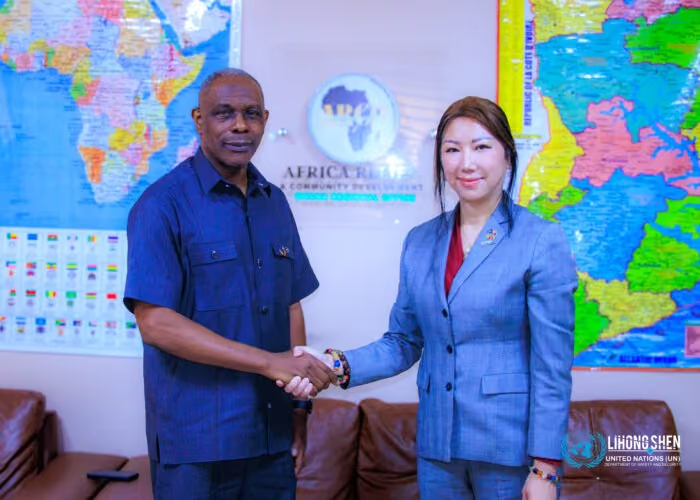
Ghana continues to serve as a strategic hub for humanitarian work in West Africa, and the strength of that work depends heavily on coordination between local organizations and international bodies. In early July 2026, the United Nations Department of Safety and Security paid an official visit to ARCD's Ghana Regional Office in Accra, a moment that reflects growing humanitarian partnerships in Ghana between grassroots relief organizations and the UN system. The visit brought together ARCD's Ghana Regional Director, Mr. Omar Barry, and Ms. Lihong Shen, the UNDSS Security Advisor for Ghana, Liberia, and Sierra Leone, to discuss how safety, security, and development work intersect on the ground.
Why Humanitarian Partnerships in Ghana Matter for Vulnerable Communities
This kind of collaboration also builds accountability into humanitarian work from the start. As the United Nations in Ghana sets out under Sustainable Development Goal 17, the 2030 Agenda depends on stronger public, public-private, and civil society partnerships; a recognition that no single organization can solve development challenges of this scale alone. ARCD's approach to community empowerment reflects that same principle, treating local ownership and external partnership as complementary rather than competing forces.
Ghana's Development Challenges and the Need for Coordinated Aid
Rural and peri-urban communities across Ghana still struggle with uneven access to essential services, and humanitarian organizations often work in areas where security planning is not optional. UNDSS exists precisely to make that kind of work possible. According to the Department of Safety and Security, UNDSS is present in 131 countries and enables the safe delivery of United Nations programs and activities in the most complex and challenging environments. That security backbone is part of what makes humanitarian partnerships in Ghana sustainable rather than one-time efforts.
The Role of the United Nations in Supporting Humanitarian Partnerships in Ghana
The United Nations Security Management System does more than protect personnel. It also creates the operational conditions that let organizations like ARCD carry out longer-term work in health, education, and clean water access without constantly starting over after a disruption. This is why a courtesy visit between a Regional Director and a UN Security Advisor carries weight beyond a single meeting. It signals ongoing dialogue between ARCD and UN entities about how to keep humanitarian delivery safe, consistent, and aligned with shared goals across the region.
>> Related Post: Six Programs, One Mission: A Complete Guide to ARCD's Programs
Inside the UNDSS Visit to ARCD's Ghana Regional Office
During her visit to Accra, Ms. Lihong Shen met with Mr. Barry to discuss ARCD's mission, structure, and the scale of its work across the continent. Mr. Barry explained that ARCD operates as both a humanitarian and development organization committed to restoring dignity to vulnerable communities while addressing the root causes of poverty rather than only responding to its symptoms. Ms. Shen expressed interest in the operational structure behind that mission and asked specifically about program scope and geographic reach, a conversation that speaks directly to how humanitarian partnerships in Ghana are built on mutual understanding rather than assumption.
What Ms. Lihong Shen and Mr. Omar Barry Discussed
The two officials focused much of the conversation on opportunities for stronger collaboration in humanitarian action, health support, and community resilience. They also discussed how ARCD's work lines up with the UN Sustainable Development Goals, particularly around peace, security, and sustainable development throughout Africa. This kind of dialogue matters because it turns a single office visit into an ongoing relationship, one where security expertise and humanitarian programming reinforce each other over time.
ARCD's Six Core Programs Driving Humanitarian Partnerships in Ghana
Mr. Barry outlined ARCD's work as resting on six core pillars, split between long-term development and emergency relief. Four of these are development focused, while two are built for urgent humanitarian response. Together they form the foundation that UNDSS and other UN entities engage with when discussing coordinated aid delivery:
- WASH, covering clean water, sanitation, and hygiene infrastructure for underserved communities
- Health, supporting access to medical care and stronger local health systems
- Education, expanding access to schooling and learning resources
- Livelihood empowerment, building skills and income opportunities for families
- Food and nutrition, addressing hunger and malnutrition through emergency relief
- Orphan sponsorship, providing ongoing support and care for vulnerable children
ARCD coordinates this work through five regional offices covering West Africa, East Africa, North Africa, Central Africa, and Southern Africa, which allows the organization to implement projects and deliver assistance consistently across the continent.
>> Related Post: Best African Charities to Donate to in 2026
How ARCD Strengthens Humanitarian Partnerships in Ghana and Across Africa
ARCD's approach to humanitarian partnerships in Ghana is not limited to a single meeting or a single program. The organization treats collaboration with UN entities, local government structures, and community leaders as part of a continuous process rather than a one-off event. This is part of why the UNDSS visit focused so heavily on operational structure and long-term coordination rather than a single project update.
Five Regional Offices, One Coordinated Mission
Operating across five regions gives ARCD the ability to respond to local needs while maintaining consistent standards across all of its programs. A community in Ghana benefits from the same WASH program framework used in East Africa, adjusted for local conditions but built on shared training, monitoring, and accountability practices. This structure is also what makes it easier for international partners like UNDSS to engage with ARCD at a regional or continental level rather than negotiating separately with each country's office.
Aligning with the UN Sustainable Development Goals
ARCD's programs map closely onto several Sustainable Development Goals, particularly those covering health, education, clean water, and reduced inequality. According to the UN Sustainable Development Goals platform, the 2030 Agenda calls for exactly this kind of alignment, treating poverty reduction, health, and education as interconnected challenges rather than separate silos. ARCD's integrated model, combining health, education, and food and nutrition support under one organization, reflects that same interconnected approach at the community level.
>> Donate to ARCD today and help extend the reach of humanitarian partnerships in Ghana and across Africa.
FAQs
1. What is UNDSS and why did it visit ARCD's Ghana office?
UNDSS stands for the United Nations Department of Safety and Security, the UN body responsible for the safety and security of UN personnel, premises, and operations worldwide. Ms. Lihong Shen, the UNDSS Security Advisor for Ghana, Liberia, and Sierra Leone, visited ARCD's Ghana Regional Office to discuss humanitarian and development initiatives and to better understand ARCD's operational structure. The visit reflects growing interest from UN entities in coordinating more closely with established humanitarian organizations operating across Africa.
2. What did ARCD and UNDSS discuss during the visit?
The discussion centered on ARCD's mission, its six core programs, and its five regional offices across Africa. Ms. Shen and Mr. Barry also explored opportunities for stronger collaboration in humanitarian action, health support, and community resilience. Both parties discussed how this kind of partnership supports the UN Sustainable Development Goals, particularly those related to peace, security, and sustainable development.
3. What are ARCD's six core programs?
ARCD's work rests on six pillars split between development and relief. WASH, health, education, and livelihood empowerment are long-term development programs, while food and nutrition and orphan sponsorship are focused on emergency humanitarian relief. Together these programs address the interconnected challenges of poverty, health, and education that many communities across Africa face at the same time.
4. Where does ARCD operate across Africa?
ARCD coordinates its work through five regional offices covering West Africa, East Africa, North Africa, Central Africa, and Southern Africa. This structure allows the organization to implement projects consistently while adapting to the specific needs of each region. Ghana falls under ARCD's West Africa regional coverage, where the organization runs programs spanning clean water, health, education, and food security.
5. Why does humanitarian work in Ghana need coordination with the UN?
Humanitarian organizations often operate in areas where security planning, logistics, and long-term stability are not guaranteed. UNDSS supports the UN system in more than 125 countries by helping ensure that programs and personnel can operate safely even in complex environments. Coordinating with a body like UNDSS gives organizations such as ARCD better tools for planning safe, sustained delivery of aid rather than short-term, disrupted efforts.
6. How does this partnership benefit communities in Ghana?
Stronger coordination between ARCD and UN entities like UNDSS supports more consistent, better-planned humanitarian delivery on the ground. This translates into clean water projects, health support, and education programs that continue running smoothly even when security or logistical challenges arise. Communities benefit indirectly from this kind of institutional partnership because it strengthens the systems behind the services they receive.
7. How does ARCD's work align with the UN Sustainable Development Goals?
ARCD's programs map closely onto several Sustainable Development Goals, including those covering clean water, health, education, and reduced inequality. The organization's integrated approach treats these issues as connected rather than separate, which mirrors the UN's own framing of the 2030 Agenda. This alignment is part of what makes ARCD an attractive partner for UN bodies seeking to support sustainable development in Ghana and across Africa.
8. Is ARCD only active in emergency relief, or does it focus on long-term development too?
ARCD does both. Four of its six core programs, WASH, health, education, and livelihood empowerment, focus on long-term development, while two, food and nutrition and orphan sponsorship, are built for urgent humanitarian response. This balance allows ARCD to respond to immediate crises while continuing to invest in solutions that build lasting community resilience.
9. What role did Ghana's regional office play in this partnership?
ARCD's Ghana Regional Office, led by Mr. Omar Barry, served as the point of contact for the UNDSS visit and the broader discussion around humanitarian collaboration. Regional offices like this one allow ARCD to engage directly with local partners, government bodies, and international organizations without losing the country-specific context that effective humanitarian work requires. This structure is central to how ARCD builds trust with partners like the UN at both the local and continental level.
10. How can I support ARCD's work in Ghana and across Africa?
You can donate directly through ARCD's website to help fund programs across WASH, health, education, food security, empowerment, and orphan sponsorship. Contributions support the same six core pillars discussed during the UNDSS visit and help ARCD maintain the operational stability that attracts stronger partnerships with international bodies. Every donation helps extend the reach of humanitarian partnerships in Ghana into more communities that need consistent, long-term support.


