
Ghana Donors Ask: Which Charities Are Worth It in 2026?
Published Date:
If you have been researching Ghana charities, you may have read that Ghana's farmers had a good year and wondered how much outside help the country still needs. The answer is less obvious than it looks. Ghana's Ministry of Food and Agriculture found that cereal production in 2025 rose 22% above the five-year average, yet its assessment for October to December 2025 counted about 1.6 million people, or 4.5% of the population assessed, in crisis-level food insecurity or worse. A strong national harvest does not reach every household, and that gap is where a well-chosen gift still counts.
Five Tests for Choosing Ghana Charities
A moving story is easy to find. Evidence takes a little more digging, and these five questions tend to separate the two.
- It names the place. Needs in Accra look very different from needs in the Upper East, so a charity should tell you the district and community it serves, not just the country.
- It works with Ghana's own institutions. Named partners such as the Ghana Education Service, district assemblies or the Department of Social Welfare suggest the work fits into public systems rather than running beside them.
- It dates its numbers. "Students supported since 1998" and "children rescued last month" describe very different things, and a credible charity makes clear which one you are reading.
- It plans for the day the funding stops. Ask who maintains the water system, who pays the teachers, or when the charity expects to step back.
- It is clear about who receives your gift. For a U.S. tax-deductible donation, check which U.S. entity will receive the money, verify its eligible status and EIN, and review its public filings where required.
No charity answers every question perfectly, and a younger organization will simply have fewer years of data. What matters is whether it answers openly when you ask. If a charity cannot tell you where last year's money went, that tells you something too.
>> Related Post: How to Donate to Charity in Africa: Make Every Dollar Count
Why Ghana Charities Still Matter in 2026
National averages hide sharp differences between Ghana's regions. The Cadre Harmonisé, the food security analysis Ghana runs with regional partners, is the clearest guide to where need sits and why; two findings from its latest round matter most for donors.
Hunger Is Concentrated in the North
The most severe hunger in Ghana sits almost entirely in the north. All 72,185 people assessed to be in Emergency (Phase 4) between October and December 2025 lived in the five northern regions, and none of the country's districts reached famine level. The table sets those five regions against Greater Accra, the capital region in the south, for comparison.
Source: Ghana Ministry of Food and Agriculture, Cadre Harmonisé Communiqué, November 2025 cycle
Upper East has about three times as many people in crisis as Greater Accra, despite having less than a quarter of its population. That is the difference between pockets of need in a city and a problem touching more than one in eight people across a region. Charities with programs in the north, including ARCD and CAMFED, are working where that share is highest.
Food Prices Rose Faster Than Harvests
A good harvest did not make food affordable for families who buy most of what they eat. The same analysis found that sorghum prices in 2025 were 89% above their five-year average and maize prices 73% above. A charity that helps households earn, save or cover school costs can matter as much as one that hands out food.
>> Related Post: How to Help Orphans in Ghana: Causes & Ways to Make a Difference
Ghana Charities to Consider and How to Choose Where to Give:
Each organization was chosen because it has active work in Ghana in named locations, a clear program focus, and public reporting updated in 2025 or 2026. They are not ranked, and inclusion is not an endorsement. Program figures are each organization's own reporting unless another source is named.
1. Africa Relief and Community Development (ARCD)
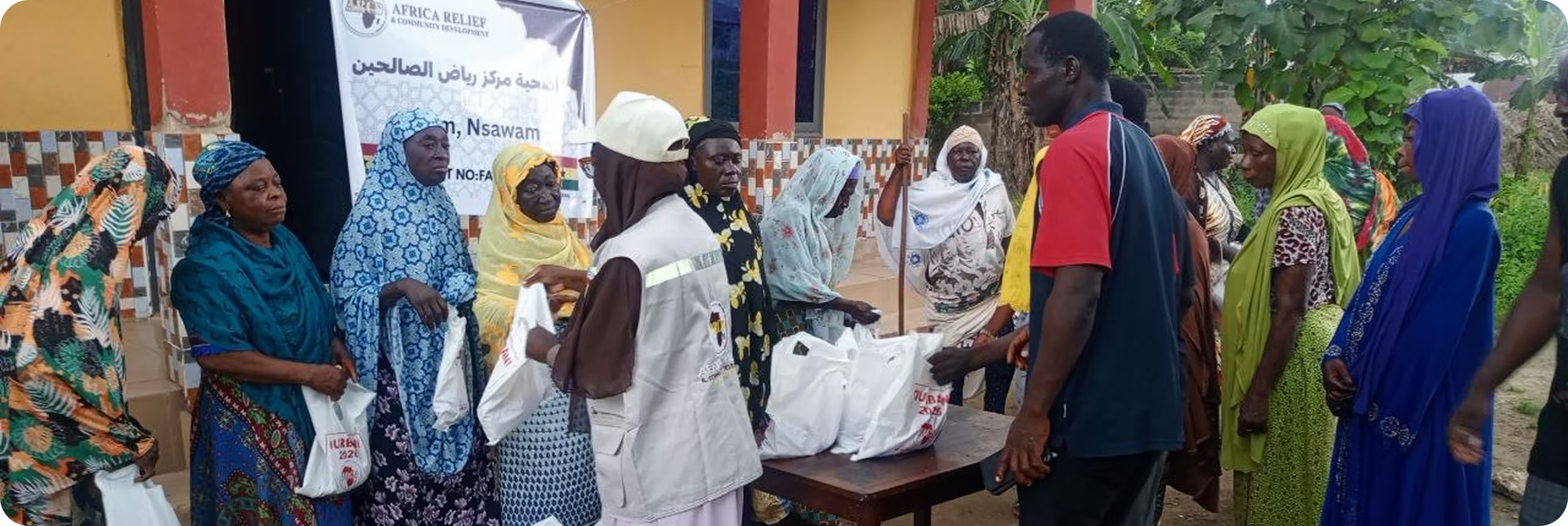
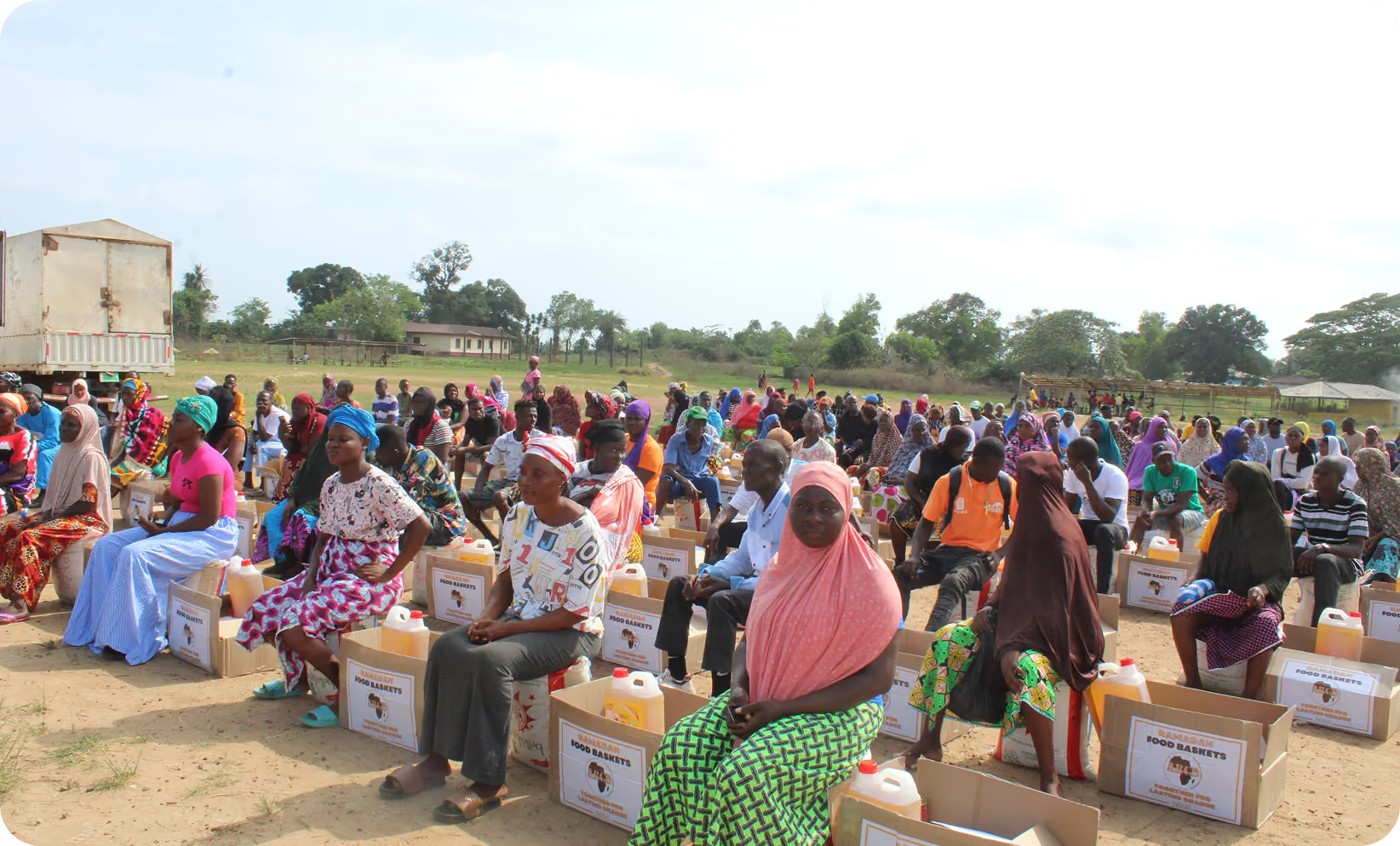
Founded in New Jersey in 2019, ARCD works only in Africa and now operates in 32 countries. In northern Ghana, its sponsorship model keeps orphaned children with the relatives raising them, and families on its current Ghana appeal live in Kumbungu District and the community of Gingaani. Households receive monthly cash support, and each child is paired with a social worker who follows their wellbeing, health and schooling.
2. CAMFED Ghana
CAMFED Ghana keeps the most marginalized girls in secondary school, with support that can cover exam fees, uniforms, menstrual supplies, books, bikes or boarding costs. It began in the Northern Region in 1998, was operating in 46 districts by 2025, and has since used donor funds to support 304,538 students through primary and secondary school. Its work runs through 1,402 government schools rather than a parallel school system.
3. Safe Water Network
Safe Water Network suits donors who care about whether water still flows in year five, not just on opening day. Since 2009 it has built community water stations in Ghana that local operators run and maintain through small water fees, and its Ghana page reports 445,000 people reached through direct access across 143 communities. It works alongside Ghana's Community Water and Sanitation Agency and district assemblies.
4. Challenging Heights
Challenging Heights rescues children from trafficking and hazardous work on Lake Volta, cares for them at its Recovery Centre and supports their return to school and family. Its founder, James Kofi Annan, was sold into forced labour in the fishing industry at six and escaped at thirteen, according to the organization. In August 2026 it announced the rescue of 25 children from Lake Volta, and it reports that it and its partners supported the rescue of 144 trafficking victims in the first half of 2026.
5. The Hunger Project Ghana
The Hunger Project appeals to donors who want their support to have an end date by design. Since 1995 it has used its Epicenter Strategy in Ghana, bringing clusters of rural villages, typically 5,000 to 15,000 people, together around a shared community facility on an eight-year path toward funding their own activities. Volunteer trainers called Animators teach methods such as composting, micro-dosing and row-planting, then pass them on to farmers in more remote villages.
Where ARCD Fits Among Ghana Charities
ARCD's main offer to donors in Ghana is family-based orphan sponsorship, and it is built to pass the five tests. It names its communities, identifies children through local teams and community partnerships rather than orphanages, and pairs each child with a social worker so progress can be followed rather than assumed. Sponsorship includes school supplies, and ARCD's wider education program builds schools and funds scholarships.
ARCD's Ghana work also includes education at a community level. At the Ahlul Quran Educational Center in Gomoa Fetteh Mamfam, where a mosque and an artesian water well came first, 291 children now study from KG1 through Basic 6. ARCD is planning a senior high school there, subject to funding and consultation with district education authorities.
>> Donate to ARCD to support community programs in Ghana, including education, clean water, food and family-based orphan care
FAQs
1. Are donations to Ghana charities tax-deductible in the United States?
Gifts sent directly to a foreign organization generally are not deductible in the U.S., so check which U.S. entity will receive the donation before you give. ARCD is a U.S. 501(c)(3) with EIN 46-2568671. For any other organization, ask which legal entity will receipt your gift, and confirm your own situation with a tax professional.
2. When do donations for hunger relief in Ghana matter most?
The lean season, which historically peaks from June to August in northern Ghana, is when stocks from the last harvest run low and market prices climb. In the survey behind the latest Cadre Harmonisé analysis, 49% of households said their main-season harvest would be used up within six months. A gift made a few months ahead of that window gives charities time to plan and buy before shortages bite.
3. Can I choose which Ghana project my donation supports?
A general donation usually lets the organization put money where it is most needed, while a program or appeal page restricts it to that purpose. If you want your gift to reach a specific country or project, ask the charity before giving whether that is possible and how it will be reported back to you.
4. Does ARCD have its own team in Ghana?
ARCD runs a Ghana Regional Office in Accra, led by Regional Director Omar Barry, which hosted the UN Department of Safety and Security's advisor for Ghana, Liberia and Sierra Leone in July 2026. Donors with questions about a specific Ghana project can contact ARCD directly through its website.


