

ARCD Distributes Back-to-School Kits to 250 Orphans in Ghana
.png)
Published Date:
In September 2026, Africa Relief and Community Development (ARCD) distributed back-to-school kits to 250 orphaned children in Salaga, in Ghana's Savannah Region. Each kit included the basic supplies a child needs to begin the school year with confidence. For children already living with the loss of a parent, that support removes one immediate barrier to staying engaged in school.
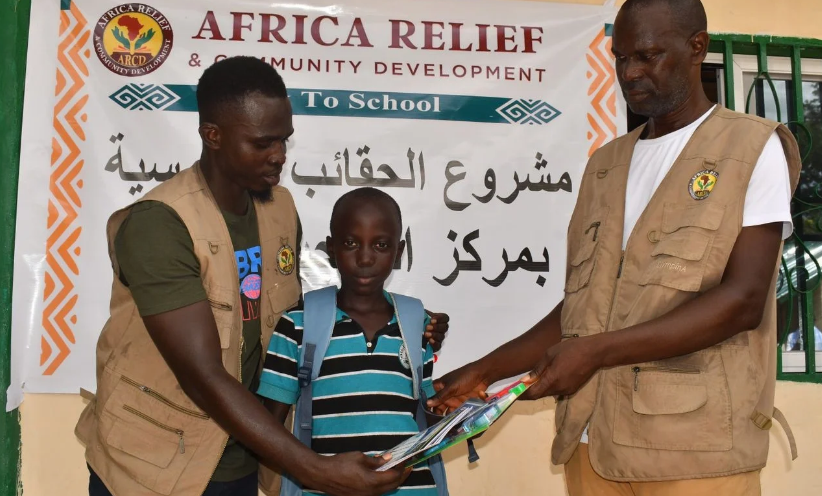
Inside the Salaga Distribution
Each kit contained:
- School bag
- Notebooks
- Pens and pencils
- Geometry set
- Color set
- Reusable water bottle
- Hand sanitizer
Why This Matters in Salaga
Salaga sits in one of the hardest places in Ghana to grow up and stay in school. More than half the people in the North East and Savannah Regions were multidimensionally poor in 2025, the highest rates in the country and more than double the national figure of 21.9%. The 2021 census found that 43.2% of children aged 4 to 17 in the Savannah Region had never attended school, the highest share of any region.
Free tuition doesn't remove every cost. The Ministry of Education's 2026 budget estimates say the government provides buildings, teachers and teaching materials, while pupils usually supply their own uniforms. School bags, exercise books and pens aren't on that list. In a household already short on several necessities, those items compete directly with food and medical costs.
>>Related Post: For Orphaned Children in Ghana, Support Can Change a Life
What Losing a Parent Does to a Child's Schooling
Ghana's 2021 census counted 846,627 children who had lost at least one parent. Most of them, 587,848, were living with a surviving mother. The Ghana Statistical Service notes that a parent's death can cut household income, and its data show that who raises the child matters. Children in households headed by a parent were 47.6% less likely to be multidimensionally poor than those living with more distant relatives or non-relatives. For children living with a grandparent, the figure was 62.0%.
The cost of school doesn't end when a parent dies. It moves to whoever takes over, and helping that caregiver cope is what keeps the child in class.
Why Free Schooling Doesn't Mean Free Schooling Costs
Under Ghana's 1995 FCUBE programme, basic schooling is free. The Ministry of Education's 2026 budget estimates say the government covers buildings, teachers and teaching materials, while pupils usually provide their own uniforms. School bags, exercise books and pens aren't on that list.
The budget leaves little room for them. UNICEF found that salaries were taking a growing share of the ministry's budget while spending on goods and services, which include learning materials, was falling:
Source: UNICEF Ghana, Education Budget Brief 2025
The 2026 budget estimates show a similar allocation pattern: GHS 32.35 billion is allocated to compensation of employees, compared with GHS 1.39 billion for goods and services, according to the 2026 budget estimates.
Over 60% of children in Ghana can't read or do basic maths by the end of primary school, UNICEF reports. A notebook won't fix that. But when budgets leave little for materials, the cost falls on families, and hardest on those who have lost an earner.
>>Related Post: ARCD Impact in Figures: Changing Lives Across Africa
What a School Kit Can and Cannot Change
A school kit will not hire teachers, shrink crowded classrooms or rebalance a national budget. It also runs out: notebooks fill up and pencils wear down long before the school year ends.
What it can do is remove one practical barrier at the moment a child needs it most, and help an orphan start the school year with the basic supplies needed to participate alongside their classmates. That is a modest goal. Keeping that child in school depends on support that continues after the first week.
How ARCD Supports Orphaned Children After the First Day
The Salaga kits came through ARCD's education program in Africa, which, according to ARCD, also funds scholarships and builds schools. For children who need more than a single distribution, ARCD offers three further forms of support.
Year-Round Orphan Sponsorship
ARCD's orphan sponsorship program combines school supplies with monthly cash assistance for the household and gifts during Ramadan and Eid. Because that support continues throughout the year, it can help with costs a one-time kit cannot, such as replacement books or transport later in the term.
A Social Worker for Each Sponsored Child
ARCD says each sponsored child is paired with a social worker who carries out regular wellbeing checks, offers psychosocial support and follows the child's health and schooling. That contact is meant to catch problems early, such as a child missing school or struggling after a bereavement.
Keeping Children With Their Families
ARCD supports orphans within their own families rather than in institutions, according to the organization. Ghana's census data also show differences in multidimensional poverty by household relationship: children living with a parent or grandparent had lower reported poverty rates than those living with more distant relatives or non-relatives.
Give to ARCD today to support education and orphan care for vulnerable children across Africa.
FAQs
1. Is basic education free in Ghana?
Tuition is. The government's 2026 budget says it provides buildings, teachers and teaching materials, and that pupils usually supply their own uniforms. Bags, exercise books and pens aren't on that list, and those are what the Salaga kits provided.
2. Why do school supplies still matter?
Without basic supplies, children may have a harder time participating fully in classroom activities. For households facing financial hardship, providing those supplies can remove one immediate education-related expense.
3. How does ARCD support orphaned children beyond one-time distributions?
Through its orphan sponsorship program, which provides school supplies, monthly cash assistance for the household and gifts during Ramadan and Eid. Each sponsored child is also paired with a social worker who follows their health and schooling, according to ARCD.
4. Does ARCD place orphans in orphanages?
No, children are supported at home with a surviving parent or relative. Ghana's census data show that children living with a parent or grandparent are less likely to be poor than those living with more distant relatives.
5. Is a donation to ARCD tax-deductible?
ARCD is a U.S. 501(c)(3) nonprofit with EIN 46-2568671, and donations may be tax-deductible to the extent allowed by law. How much you can deduct depends on your own filing situation and the type of gift. A qualified tax professional can confirm how the rules apply to you.


