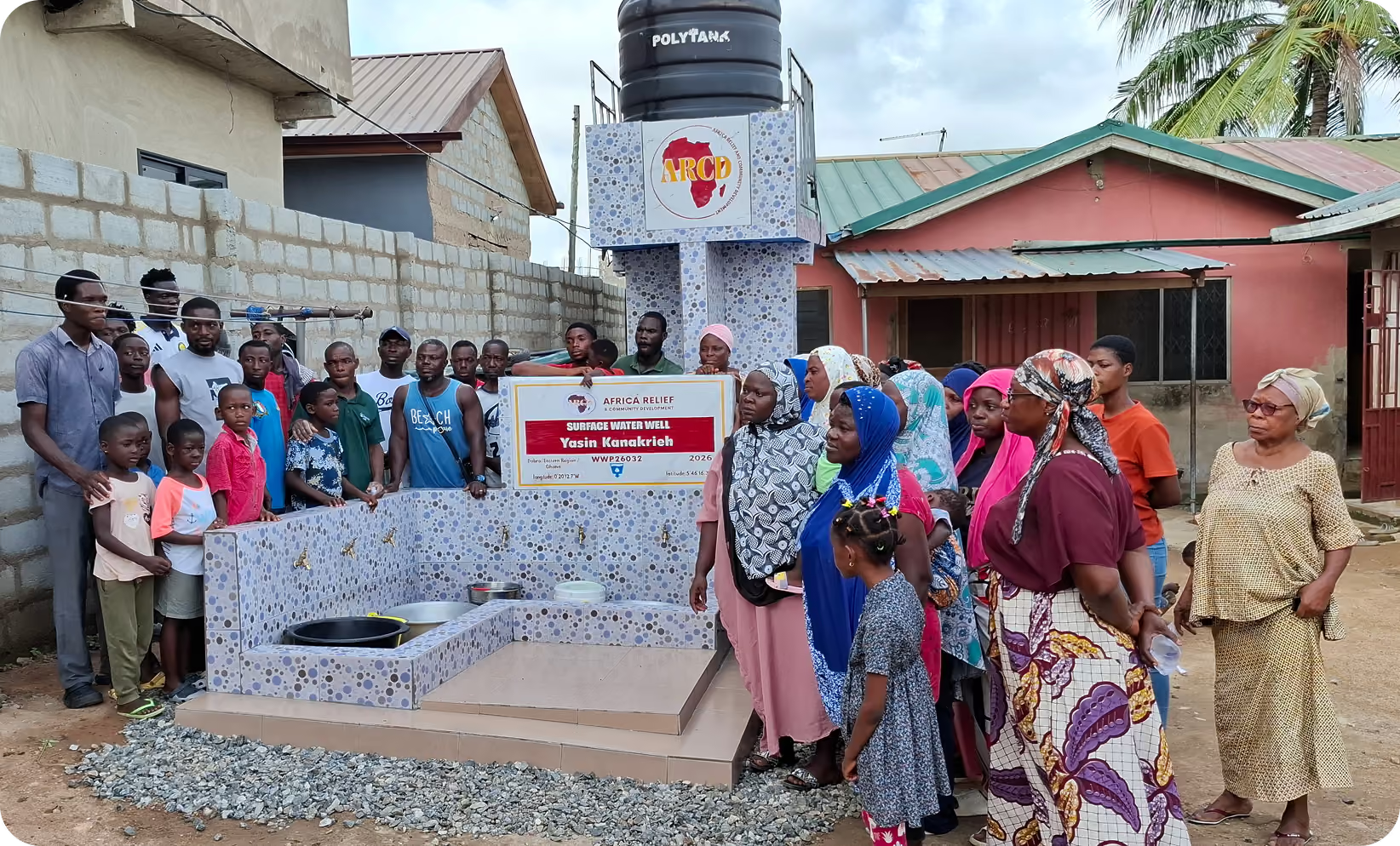
.avif)
Ghana is often held up as one of West Africa's steadier, faster-growing economies, yet a large share of its rural population still cannot count on a safe source of water at home. The reasons go beyond simple rainfall shortages. Pollution, aging infrastructure, and geography have combined to leave entire regions without a reliable option. Water wells in Ghana offer one of the few solutions that can be built, funded, and handed over to a community within months rather than years.
Ghana's water problem is unusual in one important way. It is not only a supply issue, it is also increasingly a contamination issue driven by illegal small-scale mining, known locally as galamsey. Recent environmental research on Ghana has documented widespread pollution of rivers and groundwater sources tied to unregulated mining activity, a threat that is now considered one of the most urgent facing the country's water sector. Officials have also reported that over half of the nation's river catchments have been degraded by a combination of mining, deforestation, and poor land use.
That contamination is compounding a supply problem that was already serious. According to reporting from Ghana's Ministry of Works, Housing and Water Resources, the country's per capita renewable water availability has fallen from about 3,000 cubic meters in the 1960s to roughly 1,650 cubic meters today, a level below the internationally recognized water stress threshold. Nearly four million Ghanaians currently depend on surface water or other limited sources for their daily needs.
Water access in Ghana splits sharply along urban and rural lines. National data shows urban coverage sitting near 96 percent, while rural coverage averages only around 34 percent, with some regions falling as low as 42 percent. Distance is not the only obstacle either, since the same reporting notes that non-revenue water, meaning water lost to leaks, theft, or system failure, is estimated at 80 percent in parts of the network, far above the international benchmark of 25 percent.

According to UNICEF Ghana, seventy six percent of Ghanaian households are at risk of drinking water contaminated with faecal matter, and the vast majority of families do not treat their water before drinking it. In practice this means a household's health depends almost entirely on whether their water source was ever protected in the first place, which is exactly the gap a properly built well is designed to close.
>> Related Post: Best Hunger Relief Charities to Donate to in 2026
The cost to build a water well in Ghana is not one fixed number, and pricing shifts a great deal depending on the region and the drilling method used. According to Asetena, a fully installed mechanized borehole typically runs between GHS 15,000 and GHS 30,000. A more detailed cost breakdown from a Ghana drilling cost guide puts the full price of a community scale project, including casing, water testing, and installation, between GHS 20,000 and GHS 60,000.
Drilling itself is generally billed per meter rather than as a flat fee. The same guide reports that drilling alone costs between GHS 150 and GHS 300 per meter, with most Ghanaian boreholes reaching between 40 and 100 meters before hitting a dependable aquifer. That figure covers only the hole itself. Casing, pump installation, water quality testing, and the hydrogeological survey required before drilling begins are each priced separately, and skipping any of them is one of the fastest ways a project fails within its first few years.
>> Related Post: Building Water Wells in Africa: Costs, Benefits, and Impact
A well built to a proper standard and looked after by a trained local committee can serve a Ghanaian community for twenty years or more. That single investment tends to ripple outward through a household's health, a child's schooling, and a family's income all at once, which is what makes Ghana community water projects such a high-leverage use of donor funding.
Ghanaian research tracking dry season water access has found a direct link between how far a household is from water and how often children, especially girls, show up to class or are pulled in to help with farm work instead. When a well shortens or removes that walk entirely, attendance improves quickly and consistently. Over years, that shift feeds into stronger literacy and more women staying in education long enough to pursue income-generating skills through programs like ARCD's empowerment initiatives.
A nearby well gives households the ability to keep a kitchen garden, raise small livestock, or irrigate through the dry months instead of losing a harvest to unpredictable rainfall. This kind of household-level resilience supports the broader food and nutrition security work ARCD carries out alongside its clean water projects, since the two challenges are rarely separate in practice.
This kind of household level resilience supports the broader food and nutrition security work ARCD carries out alongside its clean water projects, a connection ARCD has explored in depth when examining the causes of food insecurity across the continent, since the two challenges are rarely separate in practice.
Clean water access sharply reduces cholera, typhoid, and the diarrheal illness that remains a leading cause of preventable death among young children in under served regions. Families who move from a contaminated stream to a protected well place noticeably less strain on already stretched local health facilities. ARCD has tracked similar compounding effects across its wider portfolio, laid out in its reporting on program impact across Africa.
>> Related Post: Best African Charities to Donate to in 2026
Africa Relief and Community Development treats clean water as one piece of a larger, connected mission rather than a standalone fix. Through its WASH program, ARCD drills new wells and repairs water points that communities have already lost access to, prioritizing regions where contamination and drought have hit hardest. Every project is built around local ownership from the start, including hands-on training so committees can manage repairs long after the drilling team has moved on to the next village.
ARCD deliberately links its water work to its programs in education and community empowerment, since a household with safe water at home is in a far better position to benefit from everything else ARCD offers. For donors giving with faith in mind, funding a well also carries the enduring weight of Sadaqah Jariyah, a form of charity whose reward continues for as long as the well keeps flowing.
>> Donate to ARCD's WASH program and help bring clean water to a Ghanaian village still waiting for one.
1. How serious is the water crisis in Ghana?
Ghana's water challenge is unusual because it combines a genuine supply shortage with a growing contamination problem. Illegal small-scale mining has degraded a large share of the country's river catchments, while the country's per capita renewable water availability has fallen well below the international water stress threshold. On top of that, urban water coverage sits near 96 percent while rural coverage averages only around 34 percent. The result is that millions of Ghanaians, particularly outside major cities, still cannot rely on a safe source close to home.
2. What is the average Ghana water well cost for a community project?
A basic mechanized borehole generally costs between GHS 15,000 and GHS 30,000, depending on depth and the pump system chosen. A complete community project, including casing, water quality testing, and full installation, typically runs between GHS 20,000 and GHS 60,000. Drilling alone is usually priced between GHS 150 and GHS 300 per meter, with most boreholes reaching 40 to 100 meters. Remote locations and rocky terrain both push the final price toward the higher end of these ranges.
3. Why is illegal mining such a big factor in Ghana's water crisis?
Illegal small scale mining, known as galamsey, disturbs riverbeds and releases sediment and chemicals into water sources that communities depend on for drinking and farming. Environmental researchers have linked this activity to the degradation of a large share of Ghana's river catchments. In many mining affected areas, once usable surface water has become unsafe, forcing communities to rely on more distant or unprotected sources. This is part of why a protected borehole, drawn from a safer underground source, has become such an important option in these regions.
4. What factors affect the cost to build a water well in Ghana?
Depth is usually the single biggest driver, since deeper aquifers require more casing and drilling time. Geology matters as well, because rocky terrain in parts of Ghana slows drilling and increases wear on equipment. Distance from major roads adds mobilization costs for remote villages, and regulatory steps like the hydrogeological survey and Water Resources Commission approval add both time and expense. Community training for long term maintenance is an additional cost that any well built to last must include.
5. What types of water wells are common in Ghana?
Hand dug wells remain common in areas with a shallow water table, though they carry a higher risk of contamination, particularly in regions affected by mining runoff. Mechanized boreholes fitted with submersible pumps are more reliable and better suited to larger communities with steady daily demand. Solar powered systems are becoming more common in areas where Ghana's electricity supply is unreliable, since they lower long term running costs. The right choice depends on groundwater depth, community size, and the funding available.
6. How long does a water well in Ghana typically last?
A well built with quality materials, fitted with a suitable pump, and maintained by a trained local committee can serve a community for twenty years or longer. Longevity depends on regular upkeep, prompt repair of worn parts, and a committee's ongoing commitment to the system. Wells that are handed over without training or a maintenance plan often fail within just a few years. This is why project design that includes community ownership matters as much as the drilling itself.
7. How many people can one Ghana water well serve?
The number of people a well can support depends on its yield and the type of system installed. A smaller hand pump borehole might reasonably serve a few hundred people in a single village. A larger mechanized system with storage and distribution piping can serve several hundred to a few thousand people, including nearby schools or health posts. Proper planning before drilling ensures the well is sized correctly for the population it needs to serve.
8. What are the main benefits of Ghana community water projects?
Ghana community water projects reduce disease, cut the time women and girls spend walking to collect water, and support small scale farming and livestock during dry seasons. Girls in particular benefit from steadier school attendance once the daily water walk is shortened or removed. Local economies also gain as families redirect saved time toward income generating work. Together, these effects make communities noticeably more resilient to drought and future water shocks.
9. Does ARCD build water wells in Ghana?
ARCD's WASH program supports clean water access for vulnerable communities across Africa, including regions of Ghana affected by drought and mining related contamination. This includes drilling new wells, repairing existing water points that have fallen into disrepair, and training local water user committees to manage upkeep. ARCD deliberately connects its water work with its programs in health, education, and food security, since safe water is the foundation the rest of that work depends on.
10. How can I support water well projects in Ghana through ARCD?
You can donate directly to ARCD to help fund the surveys, drilling, pump installation, and training that make a Ghana water well possible. Contributions at any level move a project forward, whether that covers part of a hydrogeological survey or a full community borehole. For donors giving with faith in mind, a water well donation also functions as an ongoing form of charity whose benefit continues for as long as the well provides safe water. Visit ARCD's website to donate today and help bring lasting water access to a Ghanaian community.